Feminist movements cover a broad range of concerns relating to gender equality between women and men. It has had a significant social impact in many countries around the world since the late 19th-century, with an acceleration in the last 60 years. Now in the so called 4th generation of feminism, with many legal battles won at least in the West, there is an increased focus on more subtle measures of equality, often through social media activism. At the same time, feminism has had to face its own demons with regards to race and transgender issues, with the latter still being a lightning rod issue for many.
Note: Given that this is one of the most familiar yet complex topic on ywoke, we will focus more on a brief structural overview of feminism and then how it interacts with other topics in the ywoke neighborhood.
The Four Waves
Often feminism is described in waves, which is a helpful way to approach this complex topic, but be aware it is not as simple and well defined as implied by these so called waves. It is a useful, if imperfect, tool for understanding feminism.
The first wave, starting in the late 19th-century, was not the first appearance of feminist ideals, but it was the first real political feminist movement for the Western world. In 1848, about 200 women met in a church and came up with 12 resolutions asking for specific rights, including the right to vote. After a long struggle the US Congress passed the 19th amendment in 1920 and gave women the vote. This was almost 30 years after New Zealand became the first country where women were given the right to vote (or at least the suppression of their right to vote ended). While the leaders of 1st-wave feminism were abolitionists (people who sought to abolish slavery during the 19th century), they still were people of their time, and their focus was on white women’s rights. This exclusion would haunt feminism for years to come, and become a backdrop to the concept of intersectionality.

The second wave of feminism took off in the 1960s and ‘70s. It built on first-wave feminism and challenged what a women’s role in society should be. This was a clear contrast with the consumer messages of what a woman was during the boom years of the post war 1950s. Inspired by the Civil Rights movement and protests against the Vietnam War, activists focused on the institutions that held women back. This meant taking a closer look at not just how, but also why women were oppressed. Traditional gender and family roles were challenged.
There were major victories in this era in the US, including the Equal Pay Act of 1963, and Roe v. Wade in 1973 (a landmark decision of the U.S. Supreme Court in which the Court ruled that the Constitution of the United States protects a pregnant woman’s liberty to choose to have an abortion without excessive government restriction). Sports was another area where women were gaining equal rights. From 1991, any new sport seeking to join the Olympic programme must have women’s competitions alongside men’s. However pay equity for women sports remains an ongoing battle.

With the second wave, three main types of feminism emerged: mainstream/liberal, radical, and cultural. Mainstream feminism focused on institutional reforms, which meant reducing gender discrimination, giving women access to male-dominated spaces, and promoting equality. Radical feminism was more postmodern and wanted to reshape society entirely, saying that the system was inherently patriarchal and only an overhaul would bring liberation. It resisted the belief that men and women were basically the same. Cultural feminism had a similar view teaching that there is a “female essence” which is distinct from men.

The third wave arrived towards the end of the 20th century. Thanks to the institutional victories of second-wave feminism, women enjoyed more rights and power going into the 1990s. They were able to think about other aspects of their identity, welcoming individuality and rebellion. Many women more freely expressed their sexuality in how they spoke, dressed, and acted. This sometimes bewildered 2nd-wave feminists, many of whom had resisted traditional femininity. While many ideas and mini-movements swirled around in this time, the one “rule” was that there were not rules. A woman should be able to freely choose how she lived her life.
Third-wave feminism also became more conscious of race. Kimberle Crenshaw, a gender and critical-race scholar, coined the phrase “intersectionality” in 1989. This term refers to how different kinds of oppression – like those based on gender and race – intersect with each other. While mainstream first and second-wave feminism had largely ignored or neglected racial disparities within gender, the third wave paid more attention.
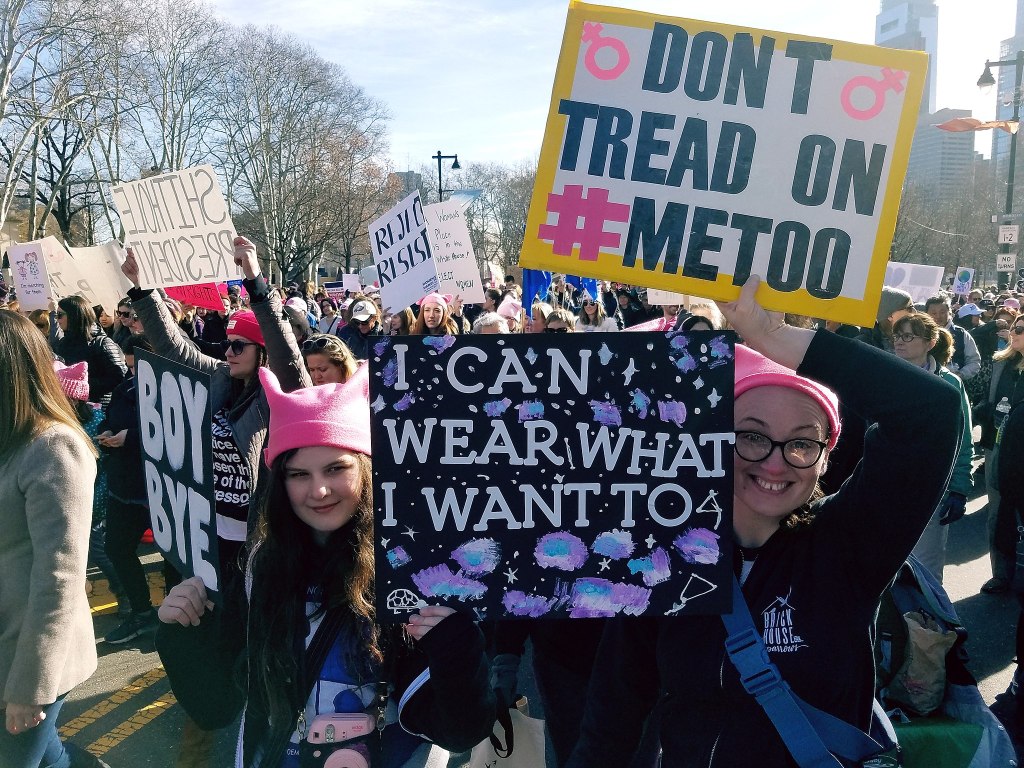
The fourth wave, if it exists, is a progression of the third wave, particularly driven by social media and increased social connectivity. This is to say that the fourth wave isn’t so much of a shift as the continued growth of the movement. However, with the #MeToo movement and a resurgence of attacks on women’s rights (including a more conservative Supreme Court in the US), many believe we are living in a new wave. Social media activism has propelled the movement firmly into the technological age. It builds on the third wave’s emphasis on inclusivity and asks hard questions about what empowerment, equality, and freedom really mean.
Fourth-wave feminism continues to reckon with intersectionality. Critics of “white feminism,” which ignores the unique struggles of women of color, expose how non-white feminists and ideas have been suppressed. Trans rights are a big part of the conversation, too. Feminism has often been an unwelcoming and hostile place for trans women and others who reject the gender binary. Nowhere is this more pronounced than in the area of sports. Many fourth-wave feminists are working to combat this exclusion. It encompasses many movements that both compliment and clash with each other. This tension is unavoidable. While some types of feminism can have harmful impacts, having a variety of voices makes feminism more inclusive and successful.
There are a significant different branches of feminism, with Liberal Feminism, Radical Feminism, Materialist Feminism, and Intersectional Feminism being among the most talked about. The below mind map takes a slightly different lens and expands on each branch, it offers one perspective on how various branches can be interpreted.

In the 4th wave, there has been an increasing influence of postmodern concepts around discourse and power. Judith Lorber, professor of sociology and gender studies summarizes the four main tendencies of the shift as:
- Making gender, not biological sex, central
- Treating gender and sexuality as social constructs
- Reading power into those constructions, power that acts in the Foucauldian sense of a permeating grid (core postmodern concept from Michel Foucault)
- Focusing upon one’s standpoint, that is, one’s identity
Some related woke concepts and theories:
- Intersectionality
- Gender Studies
- Identity Politics
- LGBT
- Queer Theory
- Post Colonial Theory
- Standpoint Theory
- Social Justice
- White Privilege
- Cancel Culture
- Lived Experiences
- Implicit Association Test
Advocates might say
- It advocates for basic human rights regardless of gender
- It has led to a increased workforce and significantly increased GDP in many countries
- Fundamental for a liberal democracy
- Reduces gender discrimination
- Has resulted in more women leaders
- Higher wages for women
- Has led to more professional sportswomen
- Has led to a more caring society
- Brings diverse thinking and better outcomes to fields like sciences
Critics might say
- Has led to excess advantages to individual women and discrimination for some individual men
- Some feminists discriminate against transgender women
- Feminism has historically racial bias by focusing on white women
- It doesn’t know when it has won and keeps making a fuss
- Men and women are different and often want different things in life
- Some women prefer traditional roles in society
- Women find they now are expected to work and do all the other tasks traditional women did
 ywoke
ywoke 