To understand Postcolonial Theory it is important to first clarify colonialism itself, which is when once country assumes political control over another country and its indigenous (original) people.
Colonialism
Note: Colonialism is a large and emotive topic with many strongly held and opposing views, and often much disagreement about key facts, so here we attempt to give a general sense of the motivation, methods, and impacts of colonialism to allow discussion on post colonial theory.
Colonialism was originally a byproduct of the explorations for new trade routes, and was motivated by economic factors that included tobacco in North America, silver in South America, spices in India, and a rich array of minerals in Africa. It typically involved not only physical control of people, but also significant influence over religion, language, and other social factors. Colonialism was often associated with atrocities, at times among the most horrific in human history (e.g. The Belgian Congo, 1885-1908, British India And The Famines, 1865-1943, Spain, The Aztecs, And Tenochtitlan, 1519-1521, Boer Concentration Camps, 1900-1902, Mau Mau Uprising, 1952-1960, Spain And The Incas, 1532-1572, The British And Australian Aboriginal Massacres, 1790s-1890s, French Algeria, 1954-1962, French Haiti, 1790s-1804, German Namibia And The Herero Genocide, 1904-1907, Dutch East Indies, 1945-1949, Amritsar Massacre, 1919, NZ Wars, 1845-1872).
There was a significant interaction between colonialism and slavery, as often readily available human labor was needed to take advantage of these economic opportunities. For example African slaves taken to work on Caribbean sugar cane plantations, or American cotton plantations.
Colonialism (though not invented by) was intensely pursued by European powers from the 16th to 20th centuries, which was a time referred to by Europeans as the Age of Discovery. This continued to the point where by the start of World War I in 1914 European powers controlled 84% of the globe. In the case of Africa only 10% of the continent was under formal European control in 1870, but at the Berlin conference of 1884 European powers agreed how they would carve up Africa, and the European control of Africa expanded rapidly to 90% by 1914. Following the conclusion of World War II in 1945 many colonies around the world started gaining their independence. This is typically referred to as the postcolonial era. The end of colonial control however has often not undone the colonial influence of culture and power distributions, with a clear example being the dividing of the Africa into many relatively small countries, which have limited cohesion and therefore global power, with some scholars suggesting that this was part of the intention all along.
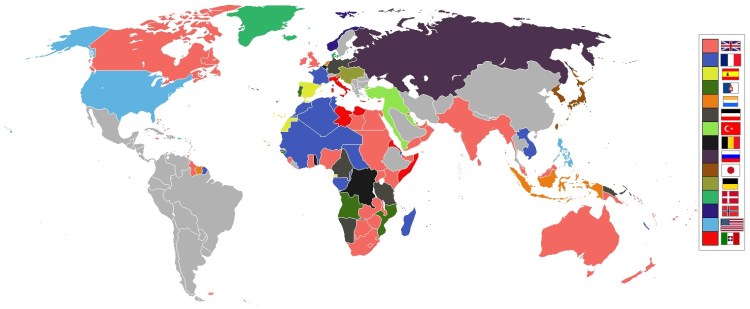
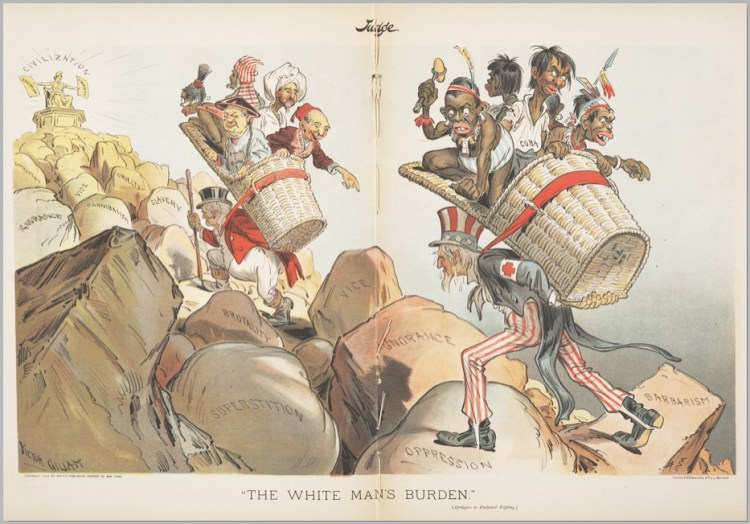
Key to understanding the ongoing impact of colonialism is how European powers justified colonizing indigenous people. Often they were only allowed (by European political and religious leaders) to take control if it was found that indigenous cultures acted immorally by European religious standards, leading to claims such as cannibalism, which were often fabricated. Post the Enlightenment this was then changed to indigenous people being devoid of logic and reason, relying on superstitious and mythology (which become key for the postmodern knowledge principle).
Warning: The below cartoon is confronting, but is the clearest way to explain the attitude (or at least justification) at the time of many colonizing powers.
The editorial cartoon “‘The White Man’s Burden’ (inspired by Rudyard Kipling poem of the same name)” depicts Great Britain and the U.S. saving the so deemed uncivilization people of the world. (Victor Gillam, Judge magazine, 1 April 1899)
Typically local indigenous cultures were downgraded or completely suppressed. A key vehicle for this was language, where in many countries indigenous languages were not allowed to be used in education, and actively discouraged or banned elsewhere. One recent example is the Te Reo Maori language in New Zealand being banned from schools; many Maori elders still remember being beaten for speaking their traditional language at school. Another example was the education system in India, where the private owned British East India company implemented a system where native languages, and even the Sanskrit writings, were banned; many of these are now understood to be among the greatest written human works, and in many regards ahead of European texts of the time.
Postcolonial Theory
Postcolonial Theory is regarded as perhaps the first, and most significant, examples of applied postmodernism, and as such is having an increasing impact on social activism, focusing on the pervasive impact of colonialism on colonized, typically indigenous, people.
Postcolonial Theory essentially recognizing that any liberal gains of colonized people is generally within the boundaries of the power frameworks of the colonizing powers (the postmodern power principle). It also recognizes that traditional forms of knowledge such as stories and myths, have been degraded by colonial powers (the postmodern knowledge principle). It therefore rejects much of the incremental gains in colonized territories advocating a full decolonization of such territories and societies, to the extent of deconstructing the west, at least with regards to colonized territories.
Generally among European powers the oriental east was regarded as peculiar and illogical. Many non European cultures have their knowledge stored in mythology and stories which were dismissed as nonsense. Europeans thought of themselves as logical and reasoned. Europeans were normal; non-Europeans were abnormal, exotic, and regarded at others. This concept of othering has become a key concept in postcolonial theory, which suggests that this othering has been a deliberate and cynical tactic, and also linking to the focus on specific and subtle language that implies that there are these attitudes and biases and therefore reinforce this othering. There are suggests that even logic and reason are used, or potentially even created, to control colonized people and deprecate their traditional forms of knowledge.
Like other forms of post modern theory this supports the idea that objective knowledge is an illusion, and knowledge cannot be true for everyone regardless of identity, because knowledge always relates to cultural values. Eastern philosophies tend to run into problems when assessed with western philosophical tools, like logic and reason, yet many westerns that make the mind-shift find eastern philosophy far richer and more sophisticated, but not particularly open to logic and reason, thought still quite open to observation and experience; it is easy to see why western colonial powers were so worried about eastern ideas.
History provides another problem, as typically it was written by the dominant colonial powers that went to great lengths to ensure it told the story that aligned to their world view (i.e. unreliable narrators). Some people feel this history ought to be corrected, or even over-corrected, to compensate and help redress the power imbalance.
Further to this is the understanding of the mixing of races, leading to confusion of identities for later generations, that struggle to be European, or to be non-European.
Some of the actions and activities at the forefront of post-colonial theory include changes to academic curriculum, removal of colonial statues and symbols, introducing indigenous culture including language, place name, holidays and festivals.
Some related woke concepts and theories:
- Standpoint Theory
- Identity Politics
- Cancel Culture
- Social Justice
- Research Justice
- Lived Experiences
Advocates might say
- Identifies the factors (systems, narratives etc) leading the ongoing suppression of indigenous peoples around the world, at an individual, local, and global level
- Enabled the correction, or redressing of historical inaccuracies that deny the many historical oppressive acts and measures used by colonial powers
- Seeks to redress the balance of power for colonized people
Critics might say
- Subscribing logic and reason as western concepts does an injustice to eastern and other non western cultures
- There is no point being stuck in the past, and the only way is to move forward from where we are today
- Look at what great advancements the colonization has brought
 ywoke
ywoke 